₹.
Why should you invest your money?
June 15, 2022
❝How many millionaires do you know who have become wealthy by investing in
savings
accounts? I rest my case.❞
—— Robert G. Allen
Let's start the discussion...!
Investing your money is a smart way to grow your wealth. Unlike traditional methods of earning money, such as exchanging time and labor, investing allows you to increase your income without being limited by your time and energy. It is a powerful tool for creating financial security and achieving your financial goals. In this blog post, we will explore the importance of investing your money and how it can help you beat inflation, maintain a good standard of living and grow your wealth over time.
Investing your money is a smart way to grow your wealth. Unlike traditional methods of earning money, such as exchanging time and labor, investing allows you to increase your income without being limited by your time and energy. It is a powerful tool for creating financial security and achieving your financial goals. In this blog post, we will explore the importance of investing your money and how it can help you beat inflation, maintain a good standard of living and grow your wealth over time.
You may have heard the word 'inflation', but you probably don't pay much
attention to it. You
may
be surprised to hear that inflation is the biggest enemy of your money. Inflation gradually
erodes the value of your money and weakens your ability to purchase goods and services.
✯ Inflation is the rate that describes how fast goods and services are becoming more expensive or, it represents the rate of depreciation of a currency's value or purchasing power.
Let us try to understand this fact, as of April 2022, Consumer Price Index (CPI) inflation rate in India was recorded at 7.79%. This indicates that the price of goods and services increased by 7.79% annually in April 2022 compared to April 2021, meaning that you would have to pay ₹107.79 in April 2022 to buy the exact same goods and services that cost you only ₹100 in April 2021. Alternatively, the purchasing power of our currency is depreciating by approximately 7.23% in April 2022 compared to April 2021.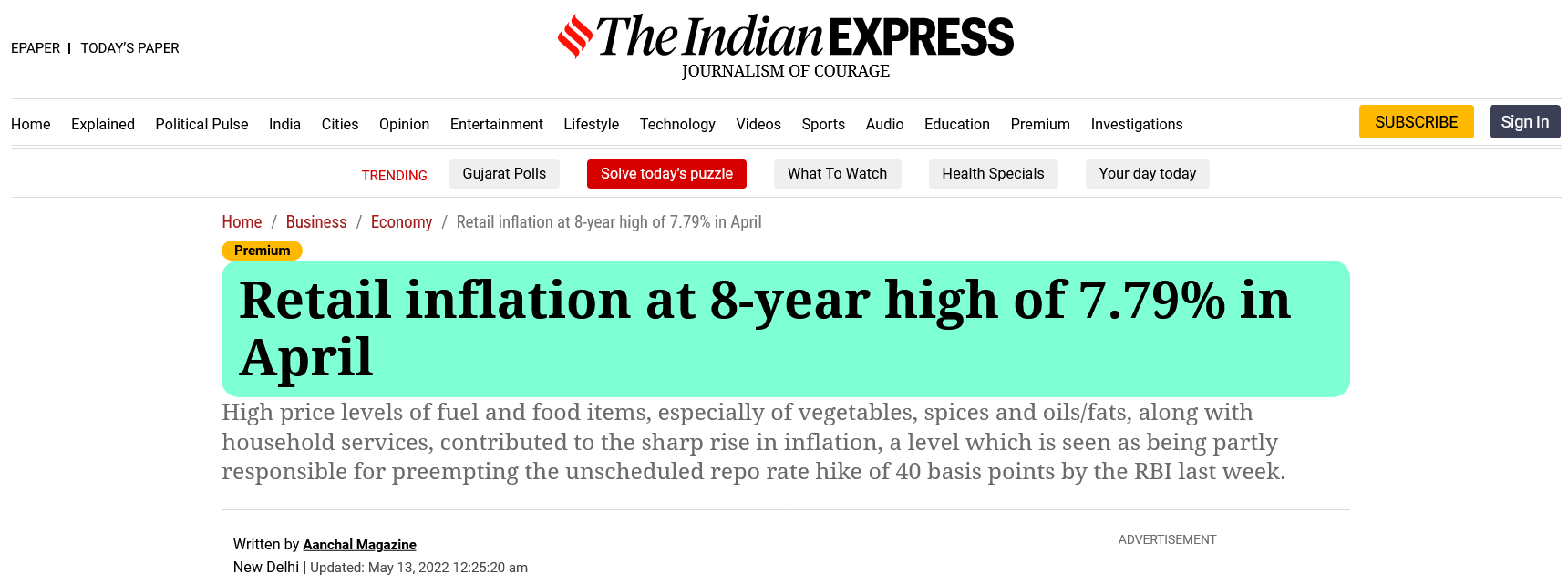 In simple words, if you have ₹1000 in your wallet, its purchasing power has depreciated by
approximately 7.23% in April 2022 compared to April 2021. Although the number of currency notes in
your wallet remains exactly the same, the value of what that money can actually buy has decreased.
As a result of 7.79% inflation, you now have to pay ₹1077.90 in April 2022 to buy the exact same
goods and services that you could have purchased for just ₹1000 in April 2021. This means your ₹1000
can now only afford 92.77% of what it could before — that is the real meaning of a decrease in
purchasing power due to inflation.
In simple words, if you have ₹1000 in your wallet, its purchasing power has depreciated by
approximately 7.23% in April 2022 compared to April 2021. Although the number of currency notes in
your wallet remains exactly the same, the value of what that money can actually buy has decreased.
As a result of 7.79% inflation, you now have to pay ₹1077.90 in April 2022 to buy the exact same
goods and services that you could have purchased for just ₹1000 in April 2021. This means your ₹1000
can now only afford 92.77% of what it could before — that is the real meaning of a decrease in
purchasing power due to inflation.
Inflation diminishes the value of money over time, meaning that the same amount of money can buy fewer goods and services than before. As prices rise due to inflation, people need to pay more money to buy things they could previously buy for less.
✯ The value of your money indicates the purchasing power of your money.
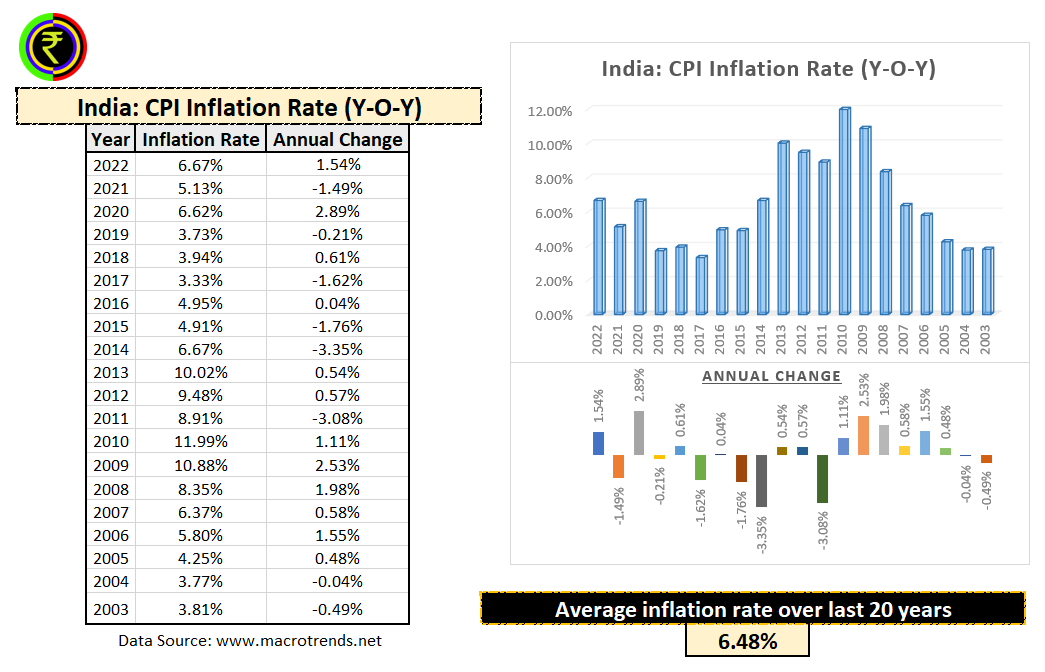 As you can see in the above figure, the average inflation rate in India in the last 20 years is
around 6%, which means that the purchasing power of your money — that is, the ability to buy goods
and services with it — is decreasing by approximately 5.66% every year (calculated as ₹100 ÷ ₹106 =
94.34%, meaning a loss of 5.66%, since purchasing power loss must be measured against the
new inflated price base). By now it should be clear to you that if you keep your money uninvested,
inflation will slowly and silently erode its value.
As you can see in the above figure, the average inflation rate in India in the last 20 years is
around 6%, which means that the purchasing power of your money — that is, the ability to buy goods
and services with it — is decreasing by approximately 5.66% every year (calculated as ₹100 ÷ ₹106 =
94.34%, meaning a loss of 5.66%, since purchasing power loss must be measured against the
new inflated price base). By now it should be clear to you that if you keep your money uninvested,
inflation will slowly and silently erode its value.
Now you must be thinking that your money is safe in a bank account, as you are getting interest on your money in the bank. But currently, most of the popular banks in India offer only 2.5 to 3.5% interest per annum on savings accounts. If your bank offers an interest rate of 3.5% on your savings account and the inflation rate is 6%, the real effective return on your money can be calculated using the Fisher Equation: Real Return = (1.035 ÷ 1.06) − 1 = 0.9764 − 1 = −2.36% This means the purchasing power of your money is depreciating by approximately 2.36% per year. If the interest rate on the savings account is even lower, say 2.5%, the real depreciation will be even faster: Real Return = (1.025 ÷ 1.06) − 1 = 0.9670 − 1 = −3.30% Therefore, it is not advisable to maintain a significant amount of funds in a savings account.
If your objective is simply the safety of your money, a bank Fixed Deposit can be a suitable option. However, if your goal is to genuinely grow your wealth and stay ahead of inflation, a bank FD may not be the best choice, as it offers little to no real return under typical conditions.
It is clear that despite earning interest on your money in a bank account, the real value of your money in a savings account can still decrease. Whereas in the case of a bank FD, the real value of your money may merely remain unchanged or potentially decrease, depending on the interplay between the prevailing inflation rate and the FD interest rate offered by the bank.
People born in India in the 1990s may remember that in their childhood, items could be bought for 50 paise, 20 paise, or even 10 paise. However, due to the continuous depreciation caused by inflation over decades, this currency has lost its real value and is now considered obsolete — a tangible example of how inflation silently destroys purchasing power over time.
To counter the effects of inflation and cultivate real growth for your money, it is advisable to consider investing as the first step. Investing is an important step in maintaining your desired standard of living, especially when your income is limited. The depreciation of your money's purchasing power due to inflation will continue to reduce your standard of living over time if left unchecked. To counter this, it is important to invest your money in a smart and sensible manner as early as possible, in order to protect against inflation and preserve your long-term financial stability.
Retail investors can invest directly, through REITs, or in joint ventures with developers but should take due diligence and expert advice before investing.
When deciding where to invest, it's important to consider your financial goals, risk tolerance, and
investment
horizon. Before you start investing you need to create a personalized investment strategy on where
to
invest, how
to invest, and how much to invest as per your needs.
Not every option is suitable for everyone, your investment options will vary according to your risk appetite. So before starting your investing journey you must be aware of your risk-taking capacity.
By investing your money, you can ensure that your money is working for you, not against you. With smart and sensible investments, you can beat inflation and maintain a desired standard of living.
In conclusion, investing your money is not only important for increasing your wealth and maintaining a good standard of living, but also for achieving financial security and independence in the long run. Be sure to do your research, and understand the risks and benefits of any investment you make. And, always remember that diversifying your investments is key to minimizing risk and maximizing returns.
✯ Inflation is the rate that describes how fast goods and services are becoming more expensive or, it represents the rate of depreciation of a currency's value or purchasing power.
Let us try to understand this fact, as of April 2022, Consumer Price Index (CPI) inflation rate in India was recorded at 7.79%. This indicates that the price of goods and services increased by 7.79% annually in April 2022 compared to April 2021, meaning that you would have to pay ₹107.79 in April 2022 to buy the exact same goods and services that cost you only ₹100 in April 2021. Alternatively, the purchasing power of our currency is depreciating by approximately 7.23% in April 2022 compared to April 2021.
In simple words, if you have ₹1000 in your wallet, its purchasing power has depreciated by
approximately 7.23% in April 2022 compared to April 2021. Although the number of currency notes in
your wallet remains exactly the same, the value of what that money can actually buy has decreased.
As a result of 7.79% inflation, you now have to pay ₹1077.90 in April 2022 to buy the exact same
goods and services that you could have purchased for just ₹1000 in April 2021. This means your ₹1000
can now only afford 92.77% of what it could before — that is the real meaning of a decrease in
purchasing power due to inflation. Inflation diminishes the value of money over time, meaning that the same amount of money can buy fewer goods and services than before. As prices rise due to inflation, people need to pay more money to buy things they could previously buy for less.
✯ The value of your money indicates the purchasing power of your money.
As you can see in the above figure, the average inflation rate in India in the last 20 years is
around 6%, which means that the purchasing power of your money — that is, the ability to buy goods
and services with it — is decreasing by approximately 5.66% every year (calculated as ₹100 ÷ ₹106 =
94.34%, meaning a loss of 5.66%, since purchasing power loss must be measured against the
new inflated price base). By now it should be clear to you that if you keep your money uninvested,
inflation will slowly and silently erode its value. Now you must be thinking that your money is safe in a bank account, as you are getting interest on your money in the bank. But currently, most of the popular banks in India offer only 2.5 to 3.5% interest per annum on savings accounts. If your bank offers an interest rate of 3.5% on your savings account and the inflation rate is 6%, the real effective return on your money can be calculated using the Fisher Equation: Real Return = (1.035 ÷ 1.06) − 1 = 0.9764 − 1 = −2.36% This means the purchasing power of your money is depreciating by approximately 2.36% per year. If the interest rate on the savings account is even lower, say 2.5%, the real depreciation will be even faster: Real Return = (1.025 ÷ 1.06) − 1 = 0.9670 − 1 = −3.30% Therefore, it is not advisable to maintain a significant amount of funds in a savings account.
✯ It is recommended to maintain a
maximum of six
months of living expenses in a savings account or liquid fund and invest additional funds to
maximize the
growth potential of your money.
Now if you keep your money in a bank Fixed Deposit (FD), it is important to note that the FD rates
offered by most well-established banks in India generally range from 6% to 7% for the general
public. In a scenario where the FD interest rate is 6% and the inflation rate is also 6%, your real
return will be: Real Return = (1.06 ÷ 1.06) − 1 = 1 − 1 = 0%, your purchasing power remains exactly
unchanged — you are merely breaking even with inflation.
However, if the FD rate is 7% and the inflation rate is 6%, your real return will be: Real Return =
(1.07 ÷ 1.06) − 1 = 1.0094 − 1 = +0.94%, this is a modest but positive real gain. However, if the
inflation rate exceeds the FD rate, or the
FD rate falls below 6%, or both, the real purchasing power of your money will decrease. If your objective is simply the safety of your money, a bank Fixed Deposit can be a suitable option. However, if your goal is to genuinely grow your wealth and stay ahead of inflation, a bank FD may not be the best choice, as it offers little to no real return under typical conditions.
It is clear that despite earning interest on your money in a bank account, the real value of your money in a savings account can still decrease. Whereas in the case of a bank FD, the real value of your money may merely remain unchanged or potentially decrease, depending on the interplay between the prevailing inflation rate and the FD interest rate offered by the bank.
People born in India in the 1990s may remember that in their childhood, items could be bought for 50 paise, 20 paise, or even 10 paise. However, due to the continuous depreciation caused by inflation over decades, this currency has lost its real value and is now considered obsolete — a tangible example of how inflation silently destroys purchasing power over time.
To counter the effects of inflation and cultivate real growth for your money, it is advisable to consider investing as the first step. Investing is an important step in maintaining your desired standard of living, especially when your income is limited. The depreciation of your money's purchasing power due to inflation will continue to reduce your standard of living over time if left unchecked. To counter this, it is important to invest your money in a smart and sensible manner as early as possible, in order to protect against inflation and preserve your long-term financial stability.
Different Types of Investments and Their Risk-Reward Characteristics:
However, there are many different types of investment options available, each with its own set of
benefits and
risks. Some popular options include stocks, bonds, mutual funds, real estate, and gold.
◉ Stocks - Stocks, also known as equity,
represent ownership in
a company
and can offer the potential for high returns, but also carry a high level of risk. Investing
in
stocks means
buying shares in a company and becoming a shareholder. As the value of the company increases
or
decreases, the
value of your investment increases or decreases.
You can invest in stocks by opening a demat account with a stockbroker and buying shares of publicly traded companies.
You can invest in stocks by opening a demat account with a stockbroker and buying shares of publicly traded companies.
◉ Mutual funds - Mutual funds are
professionally managed
investment
portfolios that pool money from many investors to buy a diversified mix of stocks, bonds, or
other
securities.
The value of your investment in a mutual fund increases or decreases as the value of the
fund's
securities
increases or decreases.
You can buy mutual fund units through a stockbroker (demat account) or directly from the website of the fund house.
You can buy mutual fund units through a stockbroker (demat account) or directly from the website of the fund house.
◉ Bonds - Bonds are debt securities that
pay
periodic interest
and return
the principal at maturity, they generally have lower returns but also lower risk. When you
buy a
bond, you are
essentially lending money to the issuer of the bond, such as a government or corporation, in
exchange for
interest payments and repayment of the principal when the bond matures.
There are many websites and apps on the internet for investing in bonds online. You can easily invest through them.
There are many websites and apps on the internet for investing in bonds online. You can easily invest through them.
◉ Gold - Gold investment in India is a
popular way for
individuals to
diversify their portfolios and hedge against inflation. Retail investors in India can invest
in
gold
through
various options such as buying physical gold, gold exchange-traded funds (ETFs), sovereign
gold
bonds (SGBs),
gold mutual funds, and gold deposit schemes offered by banks and financial institutions.
✯ As a retail investor, the best
option
for
investing in gold is SGB(Sovereign Gold Bond issued by the Government of India).
◉ Real estate - Investing in real estate in
India can be
lucrative,
offering both potential long-term capital appreciation and steady rental income, but it also
carries
the
potential risk
of fluctuating property prices and not getting tenants. Fluctuations in interest rates and
economic
conditions
also affect the value of investments. It can also be quite illiquid.Retail investors can invest directly, through REITs, or in joint ventures with developers but should take due diligence and expert advice before investing.
The Bottom Line:
Now it is crystal clear to you why investing your money is so important.
Before investing, you should make
sure that the amount of your investment is not affecting your daily life and that you have enough
money separately for your daily expenses and your emergency use. You should ensure that the money
you plan to invest is not something you will require for your immediate or near-term needs, ideally
for a minimum period of at least 5 years. Not every option is suitable for everyone, your investment options will vary according to your risk appetite. So before starting your investing journey you must be aware of your risk-taking capacity.
By investing your money, you can ensure that your money is working for you, not against you. With smart and sensible investments, you can beat inflation and maintain a desired standard of living.
In conclusion, investing your money is not only important for increasing your wealth and maintaining a good standard of living, but also for achieving financial security and independence in the long run. Be sure to do your research, and understand the risks and benefits of any investment you make. And, always remember that diversifying your investments is key to minimizing risk and maximizing returns.